1:24 Mazda RX-7 Le Mans 24h 1981 #38
Pre-order Now
Was: £49.99
Price Now: £44.98

Brand: Beemax / NUNU

Part No: BX24040
HS Code: 9503003500
Origin Country: China


Due For Christmas 2026
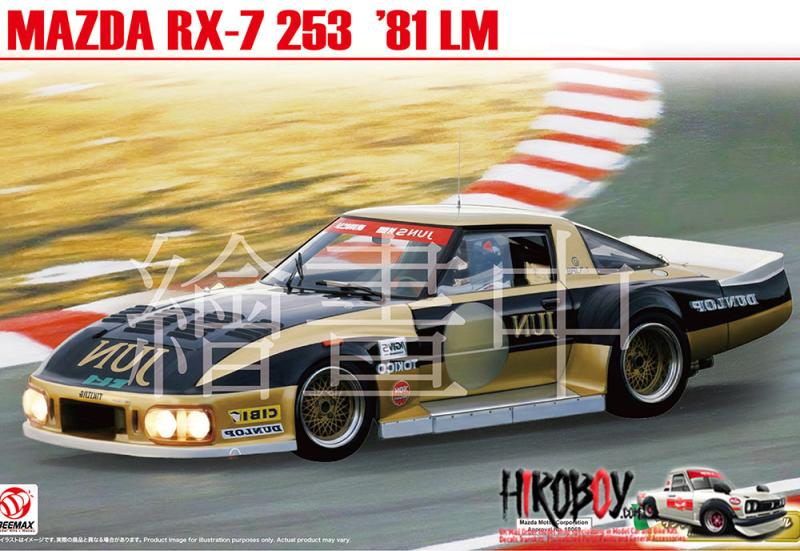
1:24 Mazda RX-7 Le Mans 24h 1981 #38
The rotary engine, on which Mazda staked its future, made its debut at the world's most demanding race, the 24 Hours of Le Mans, in 1970. It was installed in the Chevron B16, a racing car entered by an overseas team. Although the car was forced to retire due to engine failure, this marked the beginning of the rotary engine's challenge at Le Mans.
The 1970s, the automotive industry focused heavily on addressing two oil crises and increasingly stringent emissions regulations. It was an era when cars and motorsports often went hand in hand. Yet, a sports car emerged that rekindled the dreams cars could inspire. That car was the Mazda Savanna RX-7, introduced in 1978. Developed to fully exploit the rotary engine's characteristics—smooth operation, compact size, light weight, and a low centre of gravity—the RX-7 earned a strong reputation, particularly in North America. The first-generation RX-7 also proved highly competitive in motorsports, securing a class victory on its debut at the 24 Hours of Daytona in 1979, the year after its introduction, once again demonstrating the rotary engine's outstanding qualities to the world.
Based on the RX-7, the Mazda RX-7 253 was developed to compete in the 1981 24 Hours of Le Mans. Entered by Mazdaspeed, it competed in the IMSA GTO class. It marked Mazda's return to Le Mans after a one-year hiatus, following the RX-7 252, which had also challenged at Le Mans in 1979 but failed to qualify. The front-midship engine was a rotary unit with two 654 cc rotors, producing around 300 horsepower. The aerodynamic optimised body, featuring a front air dam and an extended ducktail, was designed by the renowned Takuya Yama. Mazda entered two RX-7 253s: car number 37, driven by Tetsu Ikuzawa, Tom Walkinshaw, and Peter Lovett; and car number 38, driven by Yojiro Terada, Hiroshi Fushiuda, and Win Percival. Both cars successfully qualified, placing 49th and 51st respectively. High expectations were placed on them for the race, but unfortunately both retired due to transmission problems. Nevertheless, the knowledge accumulated during this period would eventually lead to the Mazda 787B becoming the first rotary-engine car to win the 24 Hours of Le Mans outright.